


The first greenfield mining project developed in Bulgaria in more than 40 years, Ada Tepe, ceased operation – as planned – earlier this year. Now in the rehabilitation phase, it is showcasing just how mining can create lasting benefits that go way beyond the initial mine life.
Ada Tepe, an open-pit mine, is located 3 km south of the town of Krumovgrad.
The mine was commissioned in 2019, with DPM Metals, the Canada-based owner, finishing up mining on July 15 of this year.
Over these circa-seven years, some 6 Mt of material was mined at an average grade of 4 g/t Au for around 50,000 t of gold concentrate.
During operation, the mine used a mining, crushing, milling and flotation processing circuit. The mining method was a conventional drill, blast, load and haul operation.
DPM spent more than double the mine life duration securing all necessary permits and building community support for the project, including obtaining the agreement of Greece as a trans-boundary stakeholder, showing the lengths operators must go to in order to obtain approval in this part of the world.
Ada Tepe faced stringent requirements due to its location within a EU Natura 2000 protected area for habitats and because of a protected underground water body located in the alluvium of Krumovitsa River – which flows below the Integrated Mine Waste Facility (IMWF). In addition, archaeological investigations revealed that Ada Tepe was the site of the earliest known gold mine in Europe.
To comply with the requirements of being in a Natura 2000 zone, and significantly reduce the overall environmental footprint, DPM Metals designed, developed and operated the IMWF.
By the end of 2026, capping and technical rehabilitation of the entire IMWF are expected to be completed. Technical and biological rehabilitation works were also completed across approximately 66% of the facility’s 41 ha design footprint.
IM recently met with Irena Tsakova, General Manager of Ada Tepe mine in Bulgaria (pictured below), to find out more about the mine’s rehabilitation plan and, in particular, the IMWF.

IM: Was this IMWF designed with the EU’s Natura 2000 requirements in mind?
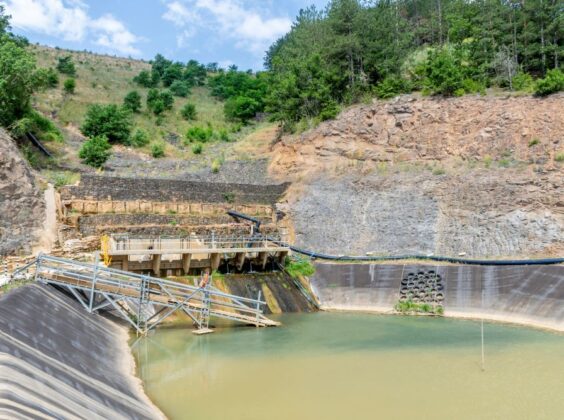
IT: From the earliest planning and design stages, Ada Tepe was developed with the Natura 2000 requirements in mind, as the facility itself was built within a protected area called the Eastern Rhodopes. There is a protected water body within the alluvium of the Krumovitsa River, which flows approximately 150 m east of the IMWF (pictured below, credit: DPM Metals).
The mine waste (waste rock and flotation tailings) stored in the IMWF is classified as “non-hazardous, non-inert” mining waste. This is based on chemical and mineralogical characterisation, acid-generation and leaching tests, and, in line with European mine waste classification criteria. Though non-hazardous, this classification does not remove the need for engineered containment, water management and long-term monitoring.
For the waste rock, rigorous laboratory analyses found that harmful elements including arsenic, cadmium, chromium, copper, mercury, nickel, lead and zinc did not exceed applicable hazardous-waste thresholds. Further acid-based accounting also indicated that the samples were unlikely to generate acid. The waste rock was therefore classified as non-hazardous, but not inert.
Testing also concluded that the tailings were not hazardous under regulation requirements and had low potential for acid generation. DPM Metals has implemented an annual testing program to monitor tailings characteristics and verify that the assumptions supporting the classification remain valid.
The IMWF has a design footprint of approximately 41 ha and a storage capacity of 23 Mt, sufficient to accommodate all the mining waste generated over the life of the Ada Tepe.
The decision to build this facility followed an assessment of two possible options for managing mine waste: a conventional tailings storage facility and waste rock dump, or an IMWF.
The IMWF is considered as one of the best available techniques for mine waste management under the EU’s Best Available Techniques (BAT) framework.
In comparison to a traditional tailings management facility, the IMWF reduced the area directly affected by the facility from approximately 100 ha to 41 ha, helping to protect habitats for two protected tortoise species – Testudo graeca and Testudo hermanni. The facility also allowed for the progressive rehabilitation of disturbed areas during operation and enabled water to be recycled, reducing the need for fresh water. The vegetation used to rehabilitate the area was selected in line with Natura 2000 habitats requirements and in consultation with the regional forestry authority, using plant species of local origin to support the restoration of the site.
IM: What are the process and main components of the IMWF? How does the facility build on other dry-stacked tailings examples from around the world?
IT: For most mines around the world, waste rock and tailings are managed separately. Waste rock is deposited in dedicated waste dumps, while tailings are stored in tailings storage facilities, often in slurry form with significant water content.
At Ada Tepe, the IMWF combines waste rock and thickened tailings within a single engineered facility designed to maximise drainage, improve long-term stability and significantly reduce risk.
Integrated tailings facilities are not a new concept. What distinguishes Ada Tepe’s IMWF from other integrated facilities is the way the tailings are managed once deposited.
The facility was engineered to continuously drain moisture from thickened tailings through a network of drainage layers and geotechnical structures. This allows the material to become progressively denser and more stable throughout its operational life and well after closure.
Unlike conventional tailings facilities, where water remains a significant component of stored tailings for decades, the Ada Tepe concept is designed to actively remove water over time. Even after mining ends, for example, the tailings stored there will continue to lose excess moisture until they reach their natural equilibrium.
The facility was developed in stages using locally sourced rock. Development started with platforms constructed in both gullies, while a pipeline conveyed thickened tailings from the process-plant thickener to multiple discharge points within the facility’s tailings cells.
As the facility grew, mine waste rock was used to build new tailings cells and berms. The outer berms contain the facility, while the internal berms separate the tailings cells, support the distribution infrastructure and provide access for mining equipment. Together, these structures contain the tailings as they progressively lose water and become more stable.
Progressive rehabilitation
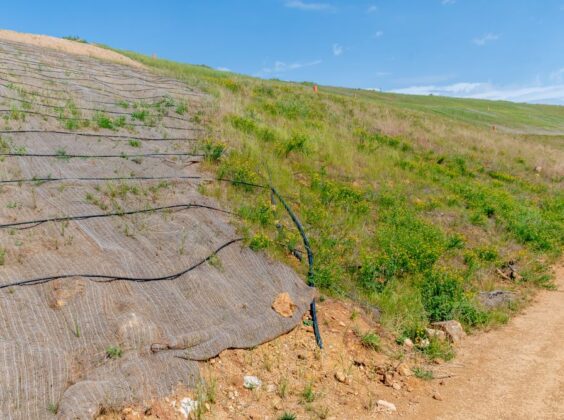
One of the IMWF’s key advantages is the implementation of progressive rehabilitation during operations (an example below, credit: DPM Metals), where individual cells are closed and rehabilitated while the mine is still operating.
This approach significantly reduces erosion processes and minimises dust emissions.
When planning the facility, one of DPM Metals’ key engineering requirements was allowing sufficient time for deposited tailings to consolidate before building additional cells. Careful sequencing was important during the early years of operation, when storage space was limited.
Close collaboration with the design and engineering teams was essential, allowing the facility to be continually refined based on lessons from the field.
We expect to have completed the IMWF capping by the end of November, and technical rehabilitation of the entire IMWF by the end of 2026. We’re on track to complete active rehabilitation of the site by the end of 2028, with the aim of delivering a stable and functional landscape to the town of Krumovgrad by 2032.
Water management
Water from rainfall, drainage and seepage is comprehensively managed and highly controlled.
An underdrain system collects rainfall and water released from the tailings during loading and consolidation. A two-zone filter system then prevents tailings particles from migrating through the outer mine-rock berms. Water drains into a collection sump at the toe of each gully, where pumps operate automatically in response to water levels and return the collected water to the water management system for reuse.
Additional seepage control is provided by a grout curtain – a barrier formed by injecting grout into the bedrock – extending approximately 540 m along the base of the facility. The curtain reduces seepage through the rock and helps limit the movement of contact water towards the Krumovitsa River. A drainage system and inclined wells, reaching depths of up to 45 m, collect seepage along the curtain. Pumping lowers groundwater levels and reduces water pressure on the barrier.
Water from the system can then be recycled and used for road dust suppression and irrigation of rehabilitated areas. Although the local climate generally results in a negative water balance, when dealing with surplus water, the IMWF uses specialised evaporators, with DPM Metals treating the water before discharging into the Krumovitsa River. The treatment plant is designed to achieve drinking-water quality with respect to chemical parameters.
DPM Metals is currently testing two types of water treatment facilities for use following full site rehabilitation. Treatment is intended to continue until inflows from the IMWF cease or the water naturally reaches a quality comparable to drinking water.
Monitoring and safety
DPM Metals plans to continue monitoring activities for at least 10 years following Ada Tepe’s closure and final reclamation, providing long-term oversight and verification of the facility’s safety, stability and environmental performance.
Monitoring takes place through an instrumentation and monitoring system, the results of which are regularly reviewed by the Engineer of Record in line with industry best practices. In addition, an Independent Tailings Review Board conducts annual reviews of the facility’s condition and management.
The monitoring system includes 40 standpipe piezometers for groundwater monitoring and 54 electrical piezometers for measuring pore-water pressures in the tailings. Vertical and horizontal berm movements are monitored using survey points referenced to four fixed points on natural ground, supplemented by 20 inclinometers and seven extensometers.
IM: Where do you think the mining industry can learn, more broadly, from the rehabilitation at Ada Tepe?
IT: One of the key lessons learned at Ada Tepe is that closure and rehabilitation should be considered from the earliest stages of mine development, rather than an activity pursued at the end of a mine’s life. Considering the best available technologies and global industry practices from these early stages is of immense value.
For example, the Ada Tepe IMWF represents a different philosophy of mine waste management: one that seeks to reduce water, improve stability, enhance safety and support responsible closure from the very beginning of a mine’s life. Since water is a key resource in ore processing, recycling it can be an important part of responsible mine management.
Success at Ada Tepe depended not only on engineering but also on collaboration. As mentioned previously, DPM Metals, the design teams and engineering teams worked in close partnership throughout planning and development, continuously refining details and incorporating practical improvements identified in the field.
This also includes broader collaboration with local communities. Rehabilitation and closure planning should always consider how to support the long-term future of communities around the mine.
DPM Metal’s 2015 Memorandum of Understanding and Cooperation with the Krumovgrad Municipality committed the parties to work together and create lasting benefits for the local communities through cooperation in economic and social development, support for small- and medium-sized enterprises, healthcare and education.
As a result, DPM Metals and Krumovgrad municipality established a unique $5 million fund to support and promote micro-, small- and medium-sized enterprises outside the mining sector.
By integrating closure planning, progressive rehabilitation, advanced water management and innovative mine waste solutions from the outset, DPM has demonstrated that responsible mining and environmental stewardship can go hand in hand, creating a world-class case study that sets new standards for sustainable mine waste management globally.
Lead photo credit: DPM Metals
The post A global benchmark for mine waste management appeared first on International Mining.

