


With bauma CHINA set to kick off next week on November 23, with IM Editorial Director Paul Moore in attendance, it is a good opportunity to consider the position of Chinese OEMs in the mining industry – and especially in the overseas market. On the one hand, in areas like battery electric and autonomous fleet operations, as well as the use of AI and 5G connectivity in mining, China is some way ahead.
At the same time, when it comes to the fundamental mining machinery itself, Chinese OEMs still face some hurdles when it comes to perception of performance in areas like post sales service, as well as product and solution consistency, and ability to match Western equivalents when the full TCO is taken into account – including overhauls and rebuilds.
This attitude is to some extent based on experience – in the past, Chinese machines in mining were often in reality less robust versions of their Western equivalents, and in some cases included attempts to recreate design aspects of the Western products. Chinese companies had already seen massive success in construction class equipment – but scaling these up to mining class sizes and 24/7 mining operation is a huge challenge. Added to that the Chinese mining market was set up to regularly replace much lower specification and lower cost machines. Of course this is somewhat ironic given that most of the Western companies were and are having major components built or sourced in China anyway.
The situation has changed massively in recent years – top global miners like BHP, Fortescue, Vale and Rio Tinto have large Chinese procurement teams that visit Chinese OEMs regularly. These Tier 1s are already buying many of their key components like mining tyres and conveyors belts, from Chinese companies. And they have signed various letters of intents and MoUs with Chinese companies focused on joint development of next generation equipment – especially electric machines, and everything that goes with that. A suite of battery electric mining equipment recently arrived in Australia to start work with Fortescue, as an example. Cooperation is also underway with major Chinese OEM agnostic autonomous haulage system providers. At the same time, Chinese miners like Zijin Mining have grown hugely in terms of their overseas mining assets, so have taken key Chinese innovations with them.
Of course the major Chinese companies like XCMG are well aware that is work to be done to reach perception parity with the likes of Caterpillar, Komatsu, Liebherr or Sandvik – the company is using what it calls its Five Modernisations framework to upgrade its manufacturing, product portfolio, and global operations. These encompass: high end – shifting from mass-market machinerco high-value, ultra-large, and technically complex equipment; intelligent – integrating AI, 5G, Big Data, and IoT ointo both factory production and machine operation; green – decarbonising heavy machinery and manufacturing operations to meet global ESG and dual-carbon targets; service oriented – moving away from one-off equipment sales toward full-lifecycle operational support; and global – expanding international market share through deep localisation rather than simple product exports.
A new survey from Harbour; The Confidence Gap – Chinese OEMs vs Western incumbents
Leading global mining and natural resources marketing, research, and advisory firm, Harbour, recently commissioned a landmark survey covering these perception issues – focusing squarely on how senior mining buyers rate Chinese equipment and technology suppliers against the Western incumbents. It polled 60 senior mining buyers from 100 top (and non Chinese) mining companies with 27 questions. The buyers included 30 on the mobile-fleet side and 30 on the processing-plant side, with at least 20 from companies already running Chinese equipment.
Key questions included – over the next five years, if they expect the share of their organisation’s capital equipment spend going to Chinese suppliers to change; and in which equipment categories would their organisation realistically accept a Chinese supplier today. IM can exclusively share some of the interim findings, which are fascinating – and are of interest both to Chinese OEMs on how to close the confidence gap, and also to show Western OEMs where their market-share is exposed.
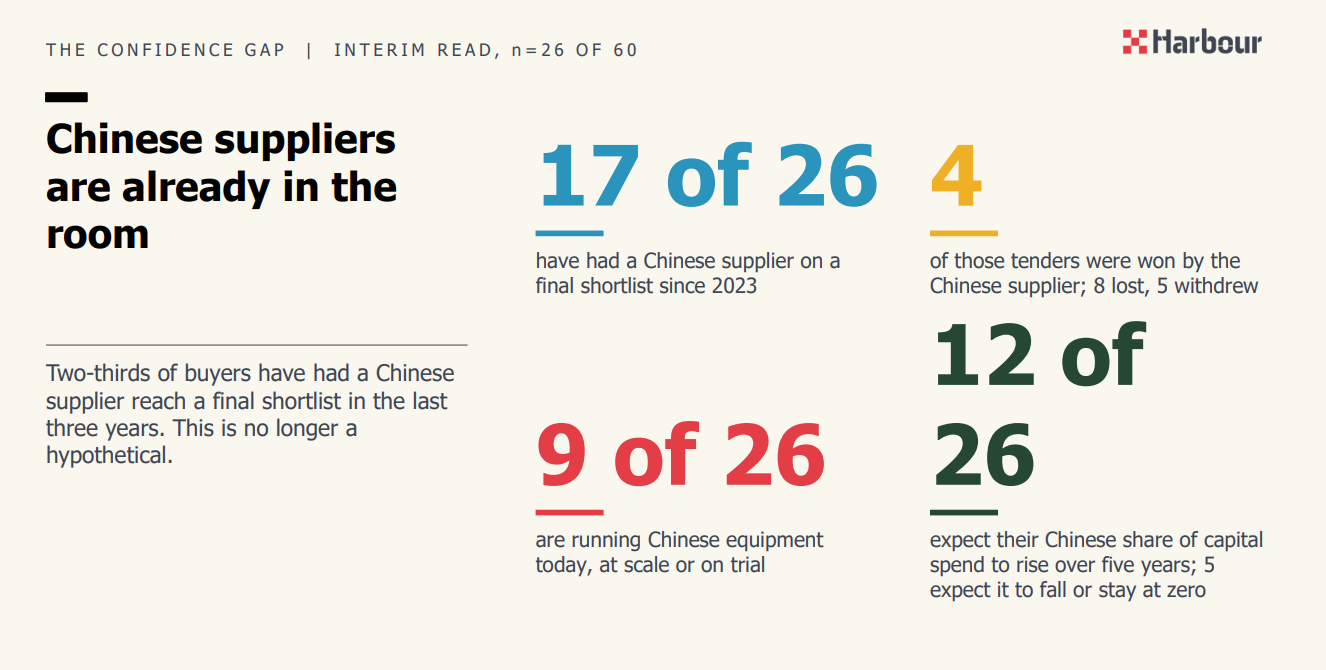
First it showed that Chinese suppliers are already in the room – 17 of an initial 26 buyer respondents have had a Chinese supplier on a final shortlist since 2023 and four of those tenders were won by the Chinese supplier, with eight Chinese suppliers losing out and a further five withdrawing. Nine of the 26 are running Chinese equipment today, at scale or on trial. And 12 of the 26 expect their Chinese share of capital spend to rise over five years. Buyers trust Western brands at 7.6 out of 10 to deliver and support a mission critical fleet or plant for next decade, while Chinese brands scored 4.1.
And it is not about the machine – it is about what happens after delivery – Chinese brands lead on price and are close on TCO. The widest gaps are dealer network, aftermarket support and reliability. Chinese equipment typically sells at 30-50% below Western equivalents. Two in three buyers would switch for 30% of less, all else being equal. Finally buyers expect parity – three in four think the leading Chinese brand in their category will reach Western-level trust – fewer than one in four think Western OEMs are responding effectively.
Those interested in exploring the full Harbour survey – ‘The Confidence Gap – Chinese OEMs vs Western incumbents’ are welcome to contact Harbour directly through Managing Partners Chris Cann, at chris@askharbour.com and Matt Smith, at matt@askharbour.com
The post Landmark Harbour survey addresses Chinese versus Western mining tech & equipment confidence gap appeared first on International Mining.
